
Screen Time • Coding • Creativity
Screen Time for Kids: Why Not All Screen Time Is Created Equal
The number of minutes a child spends on a screen tells only part of the story. What they are doing—watching, playing, communicating, designing, coding, researching, or creating—changes the learning value of that time.
Originally published July 30, 2026
Move beyond one number
Families often talk about screen time as if every digital activity were interchangeable. Watching a stream of short videos, video chatting with a grandparent, editing a movie, writing code, and designing a Minecraft mod all happen on screens—but they ask very different things of the child.
A more useful question is: What is the child doing with the technology?
Consumption and creation are different experiences
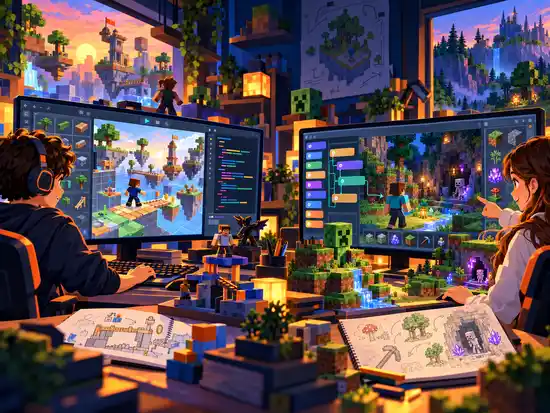
Digital consumption can be relaxing and entertaining, and there is nothing inherently wrong with entertainment. But creation asks the learner to make decisions. A child designing a Roblox game or Minecraft mod has to form an idea, break it into parts, use tools, solve problems, test the result, and revise it.
That shift—from receiving an experience to shaping one—is one reason Create2Discover focuses on helping kids become creators rather than only users of technology.
Look for active thinking
Constructive screen activities often include one or more of these behaviors:
- Planning what to make
- Solving a problem
- Learning a new tool or technique
- Writing or changing code
- Designing graphics, models, or game spaces
- Testing an idea and debugging mistakes
- Explaining a creation to someone else
- Collaborating toward a shared goal
Ask your child to show you what they made
A simple way to understand a digital activity is to ask for a demonstration. “Show me what you created” or “What was the hardest part?” can reveal whether the child was passively consuming or actively thinking and building.
Creation still needs balance
Productive screen use does not eliminate the need for sleep, movement, face-to-face relationships, outdoor time, or other interests. The point is not that coding time should be unlimited. It is that families can make better decisions when they consider the quality and purpose of the activity as well as the duration.
AI makes this distinction even more important
As AI tools make it easier to generate code, images, and ideas, kids will need more than the ability to click a button. They benefit from understanding how digital projects work so they can set goals, judge outputs, spot mistakes, debug problems, and decide what should be changed.
Learning to code and create directly can give students the background they need to use powerful tools more thoughtfully later.
Turn game interest into creation
If your child already loves Roblox or Minecraft, the game can become the starting point for learning how digital experiences are made.